Reputation Is 40× More Powerful Than Impressions: The $45 Trillion Proof That Changes Everything About Cannabis Media
There is a number that changes everything about how you think about cannabis media. It is not the number of cannabis consumers worldwide — though 244 million is extraordinary. It is not the projected market size of the legal cannabis industry — though $100 billion by 2030 is undeniable. It is not even the 850 million people whose lives are touched by cannabis culture — though 1 in 8 humans alive today is a figure that should stop every media buyer on earth cold.
The number that changes everything is this: 40.
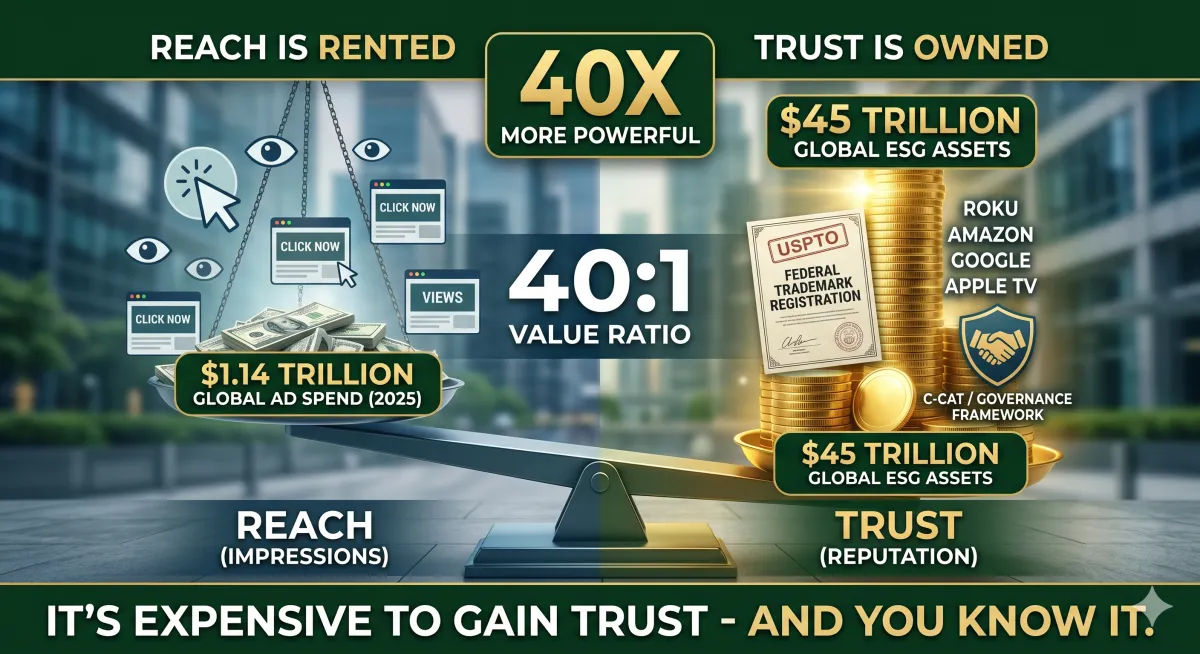
Forty is the ratio between what the world spends to reach people and what the world spends to be trusted by them.
Global advertising spend — every campaign, every impression, every media buy on every platform across every market on earth — totaled $1.14 trillion in 2025, according to WPP Media. That number represents the full weight of humanity's effort to put messages in front of eyeballs.
Global ESG assets under management — the capital committed by institutions, sovereign funds, pension funds, endowments, and corporations specifically to build, protect, and defend reputation — now exceed $45 trillion, according to Bloomberg Intelligence and Fortune Business Insights, with projections reaching $180 trillion by 2034.
Forty-five trillion dollars deployed in the service of reputation. One point one trillion deployed in the service of impressions.
Forty to one.
The world's largest, most sophisticated capital allocators — the people who move markets, set institutional policy, and determine where trillions of dollars flow — have already done this math. They have concluded, with the precision that only capital can express, that reputation is approximately 40 times more valuable than reach.
Impressions get you in front of people. Reputation determines what they do when they see you.
What ESG Capital Actually Is
To understand why this ratio matters for cannabis media specifically, it helps to understand what ESG capital actually represents — because it is widely misunderstood as an environmental or ethical investment category when it is, at its core, a reputation management instrument at civilizational scale.
ESG stands for Environmental, Social, and Governance. But the reason $45 trillion flows into ESG-aligned investments is not primarily philosophical. It is actuarial. It is risk management. It is the recognition — confirmed by decades of market data — that companies with strong ESG profiles outperform their peers on long-term risk-adjusted returns because they are better positioned to maintain the trust of the customers, employees, regulators, and communities they depend on.
In other words: ESG capital is not charity. It is the world's most sophisticated bet on the long-term financial value of being trusted.
And the institutions making that bet — at $45 trillion and climbing — are saying something explicit: trust is worth 40 times what reach is worth.
The Impression Economy's Dirty Secret
The advertising industry has spent decades building an elaborate apparatus to measure reach. Impressions. Click-through rates. Cost per acquisition. Viewability scores. Frequency caps. Programmatic optimization. Attention metrics. The vocabulary of the impression economy is precise, data-rich, and almost entirely focused on a single question: did the message get in front of the person?
What it systematically fails to measure — what it is structurally incapable of measuring — is the question that actually determines long-term brand value: did the person trust the brand before, during, and after the message?
This is the gap that $45 trillion in ESG capital is filling. It is the recognition that the impression economy, for all its sophistication, is measuring the wrong thing. Or more precisely: it is measuring one necessary thing while ignoring the thing that makes it sufficient.
You can reach 850 million people with a message. If those 850 million people don't trust you, you have purchased attention without earning permission. And attention without permission is not marketing. It is noise.
The cannabis community — 244 million consumers and 850 million people in the full cultural footprint — is the most trust-sensitive audience in modern media history. They have spent decades being lied to by institutions. They have watched the government classify their plant as more dangerous than opioids while an opioid crisis killed hundreds of thousands. They have watched platforms deplatform cannabis creators without warning or explanation. They have watched brands enter their space cynically, extract value, and exit when the legal or reputational winds shifted.
They remember every single one of those brands. And they remember every brand that showed up before it was easy — and stayed.
The Cannabis Media Reputation Gap
Here is the uncomfortable truth that $45 trillion in ESG capital illuminates about the cannabis media landscape: most cannabis advertising has been optimized entirely for impressions, with almost no infrastructure for reputation.
Dispensary ads chasing clicks. Influencer posts optimized for engagement. Programmatic buys targeting cannabis-adjacent keywords. These are impression-economy tools applied to a trust-economy audience. They can generate reach. They cannot generate the deep, durable community trust that the 850 million cannabis-connected people are actually capable of delivering to the brands that earn it.
The reason is structural. Impression-economy tools measure outputs — views, clicks, conversions. Reputation is built through inputs — consistency, authenticity, legal standing, demonstrated commitment, and the kind of track record that cannot be manufactured in a campaign cycle.
U.S. WEED CHANNEL was built to generate both — but it was designed from the ground up around the inputs that create reputation, because Shane Doull understood 12 years ago what the $45 trillion ESG market has since confirmed: reach is rented. Trust is owned.
The Infrastructure of Trust
What does a reputation infrastructure actually look like in cannabis media? It looks like this:
Federal trademark registration. USWC Media, LLC holds three active USPTO trademark registrations — the first cannabis-related intellectual properties ever issued by the USPTO to a media organization. These are not marketing claims. They are federal legal documents that establish USWC's legitimacy in the eyes of the most rigorous institutional gatekeepers in the country. When a brand's legal team needs to know whether a cannabis media partnership is defensible, a USPTO registration is the answer they are looking for.
Platform approval history. Google AdSense publisher approval. Amazon programmatic approval. Active streaming presence on Roku, Apple TV, Google TV, LG, Samsung, iOS, and Android. These approvals were not granted simultaneously. They were earned one at a time, over years, by demonstrating compliance standards that most cannabis publishers cannot meet. Each approval is a data point in a reputation record — a documented history of operating within the rules when the rules were difficult to navigate.
Legal precedent. Shane Doull's two landmark legal victories — a proven Internal Affairs case against the Riverside County Sheriff's Department and America's first unanimous not-guilty verdicts for dispensary operation against the Orange County Sheriff's Department — are not footnotes. They are the foundation. They represent a founder who faced the full weight of institutional opposition to cannabis and prevailed, twice, on the record. That is not a brand story. That is a trust credential.
C-CAT. The Cannabis Center for Advertising Transparency is the formalization of USWC's reputation infrastructure into a participation portal for mainstream brands. C-CAT provides the vetting, documentation, disclosure standards, and participation records that transform a brand's cannabis media relationship from an informal adjacency into a defensible, auditable, reputation-positive commitment. It is, in the language of the ESG capital markets, a governance framework — the G in ESG — applied to cannabis advertising for the first time.
The 40× Opportunity
Here is what the reputation math means in practical terms for the brands paying attention.
The cannabis consumer who encounters a brand through an impression has seen an ad. The cannabis consumer who encounters a brand through a trust relationship has been invited into a community. The difference between those two experiences is not incremental. It is structural. And the structural difference in long-term brand value — in loyalty, advocacy, repeat purchase, and resistance to competitive displacement — is what $45 trillion in ESG capital is betting on.
The brands that understand this are not asking whether cannabis media reaches enough people. They know it does — 244 million consumers, 850 million connected people, streaming in 180 countries across every major platform. The brands that understand the 40× ratio are asking a different question: is this a partner that can help us build reputation with this community, not just reach?
That question has exactly one answer in cannabis media in 2026. And it is built on 12 years of federal trademark protection, legal victories, platform approvals, compliance infrastructure, and a founder who has been in this community since before most cannabis brands existed.
What Happens to Brands That Get This Wrong
The $45 trillion ESG market is not just a positive signal for brands that build reputation. It is a warning for brands that destroy it.
The ESG capital allocation model is, at its core, a reputational risk management system. The institutions deploying that $45 trillion are not just rewarding companies with strong reputations — they are actively reducing exposure to companies with weak ones. ESG-aligned funds screen for companies whose practices create reputational liabilities: environmental violations, labor issues, governance failures, and increasingly, discriminatory platform policies toward protected demographics.
The cannabis community is not a protected class in the legal sense. But it is 1 in 8 people on this planet — a demographic at a scale that makes exclusion a material reputational risk by any reasonable institutional measure.
The corporate platforms still restricting cannabis media access are not making a neutral compliance decision. They are accumulating a reputational liability that $45 trillion in ESG capital already knows how to price. And as ESG assets grow toward $180 trillion by 2034 — as institutional scrutiny of corporate social practice deepens — the cost of that liability will not decrease.
It will compound.
The Scoreboard
Global advertising spend: $1.14 trillion. Optimized for reach. Measured in impressions. Rented by the campaign.
Global ESG reputation capital: $45 trillion. Optimized for trust. Measured in decades. Owned by the brands that earn it.
Ratio: 40 to 1.
Cannabis audience: 850 million people. The most trust-sensitive, brand-loyal, and institutionally underserved media audience on earth.
Infrastructure to reach them with both reach and reputation: one network. Twelve years in the making. Federally certified, globally streaming, and ready now.
The math is not complicated. The opportunity is not ambiguous. And the community is not waiting.
Stick that in your pipe and smoke it.
~ Shane
Shane Doull is the Founder and President of USWC Media, LLC, parent company of U.S. WEED CHANNEL and C-CAT. He writes about cannabis media, advertising compliance, and the future of cannabis culture from Newport Beach, California. He can be reached for comments, collaborations, and speaking engagements at +1 (424) 777-USWC (8792) ext 420.