The Last Gatekeepers: Why Corporate Stalwarts Can No Longer Afford to Ignore 850 Million People
There is a moment in every major cultural shift when the institutions still holding the gate realize the crowd on the other side is no longer a fringe — it is the mainstream. That moment, for cannabis media, has arrived.
Most of the platforms have recognized it — and U.S. WEED CHANNEL is the reason they had a model to recognize. USWC holds active Google AdSense publisher approval. Active Meta pages across Facebook and Instagram. Active streaming presence on Roku, Apple TV, and Google TV. Active mobile applications on iOS and Android. Active programmatic approvals with Amazon, LG, and Samsung. YouTube and TikTok presences operating within full platform compliance.
This did not happen by accident. It happened because USWC spent 12 years building the only cannabis media compliance architecture in existence — one rigorous enough to satisfy the most restrictive gatekeepers in digital media, one documented enough to withstand legal scrutiny, and one durable enough to still be standing after a decade of platform policy shifts that eliminated most cannabis publishers from the ecosystem entirely.
USWC is not one of many cannabis networks that found its way onto these platforms. It is the network that proved it could be done.
And yet, a handful of corporate stalwarts remain at the gate — not because the compliance case hasn't been made, not because the audience isn't real, and not because the infrastructure doesn't exist. They remain because inertia is comfortable, legal caution is institutional, and nobody inside the organization has made the reputational calculus explicit enough to force a decision.
This article makes that calculus explicit.
What "Stalwart" Actually Means in 2026
The word stalwart carries connotations of strength and reliability. In the context of cannabis media access, it has come to mean something different: an institution whose historical position has calcified into policy long after the conditions that created that position have changed.
The stalwart position on cannabis media was defensible in 2010. Cannabis was federally illegal in every state. Public opinion was divided. The consumer demographic was undefined and undersized. Legal exposure was real and asymmetric.
None of those conditions exist in 2026.
Cannabis is legal for recreational use in 24 states and Washington D.C. Medical cannabis is legal in 38 states. Federal rescheduling discussions are active and accelerating. Global cannabis consumer population stands at 244 million — with a total cultural footprint touching 850 million people, or 1 in 8 humans alive today. Public support for cannabis legalization in the United States has reached historic highs, consistently exceeding 70% in national polling.
The stalwart position is no longer defensible on policy grounds. What remains is something more uncomfortable: it is a choice. And choices at this scale have reputational consequences.
The Reputation Math
Every corporate communications team understands reputation math, even if they don't call it that. It works like this: the risk of association with a controversial position is weighed against the risk of being seen as exclusionary, discriminatory, or out of step with the culture you claim to serve.
For most of the 20th century and into the early 21st, the reputation math on cannabis favored caution. The stigma was real. The legal exposure was real. The upside of association was unclear.
That math has inverted — and the proof is in the spend.
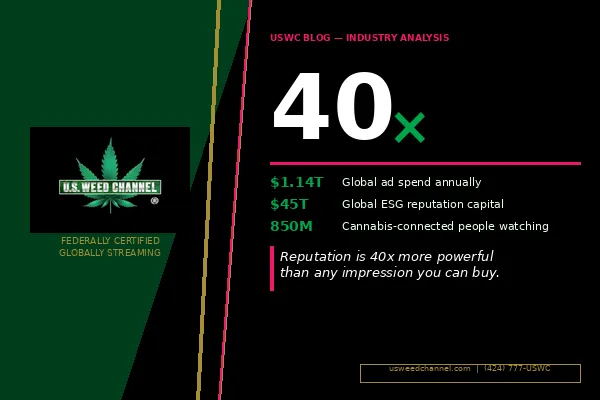
Total global advertising revenue — every impression, every campaign, every media buy across every platform and channel on earth — reached $1.14 trillion in 2025, according to WPP Media. That is an extraordinary number. It is also, remarkably, not the biggest number in the room.
Global ESG assets under management — the capital that institutions, funds, and corporations commit specifically to protect, build, and defend reputation — now exceed $45 trillion, according to Bloomberg Intelligence and Fortune Business Insights, with projections reaching $180 trillion by 2034.
Read that again. Forty-five trillion dollars deployed in the service of reputation, versus $1.14 trillion spent on impressions. That is not a rounding error. That is a 40-to-1 ratio — empirical, market-validated proof that the world's largest capital allocators have already done this math and reached the same conclusion: reputation is approximately 40 times more powerful than any impression you can buy.
Impressions reach people. Reputation moves them.
Which means the corporate stalwart who withholds platform access from 850 million cannabis-connected people is not making a neutral compliance decision. They are making a reputation decision — one that the market already knows how to price. And in a world where $45 trillion is actively managed around reputational risk, the cost of being on the wrong side of a demographic at scale is not theoretical. It is calculable.
When a platform restricts access to cannabis media while simultaneously serving content about alcohol, gambling, tobacco, pharmaceutical drugs, and violent entertainment — all of which carry documented health and social risks — the restriction is no longer a policy. It is a statement. And 850 million people are reading it with the same analytical clarity that $45 trillion in ESG capital already has.
The statement says: your culture is less legitimate than these others. Your media is less worthy of distribution. Your audience is less deserving of the platform access that every other demographic takes for granted.
At $1.14 trillion in global ad spend, that position is uncomfortable. At $45 trillion in reputation capital — growing to $180 trillion by 2034 — it is indefensible.
The Demographic You Cannot Afford to Alienate
Cannabis consumers are not a monolith, and that is precisely the point.
They are veterans managing chronic pain. They are seniors with Alzheimer's and arthritis. They are cancer patients navigating chemotherapy. They are athletes managing the physical toll of professional sports. They are parents in legal states who have made an informed choice about their wellness. They are professionals, creatives, entrepreneurs, and working people in every industry, every income bracket, and every political affiliation.
They are also consumers. Consumers of streaming platforms. Consumers of e-commerce ecosystems. Consumers of devices, services, and subscriptions sold by the same corporate stalwarts whose platforms restrict cannabis media access.
The average cannabis consumer household in a legal market makes purchasing decisions across dozens of product categories annually. They choose streaming services. They choose e-commerce platforms. They choose devices. And increasingly — with brand loyalty data from legal markets confirming this trend — they are factoring brand behavior toward their community into those choices.
A platform that restricts cannabis media access is not invisible to this demographic. It is noticed. Discussed. Shared. And in a world where consumer sentiment travels at the speed of social media, "noticed" is the first step toward "consequential."
The Compliance Case Is Already Made
The argument that corporate caution around cannabis media stems from genuine compliance uncertainty had merit five years ago. It does not have merit in 2026.
U.S. WEED CHANNEL holds three active USPTO trademark registrations — the first cannabis-related intellectual properties ever issued by the USPTO to a media organization — covering both broadcasting and digital advertising services. USWC holds active Google AdSense publisher approval. Active approvals with Amazon's own programmatic advertising infrastructure. Active streaming presence on Roku, Apple TV, LG, Samsung, and every major connected TV platform.
The compliance infrastructure has been built, documented, and verified by the most rigorous gatekeepers in the industry. The paper trail exists. The legal framework is established. The platform precedents are set.
What remains for the last corporate stalwarts is not a compliance question. It is a will question. And the longer the will question goes unanswered, the louder the answer becomes.
What History Teaches About Late Movers
Corporate history is littered with the reputations of institutions that held the gate one cycle too long.
The broadcast networks that refused to cover civil rights until the images became unavoidable. The financial institutions that excluded women from credit until legislation forced their hand. The advertising industry that ignored multicultural audiences until the demographic math became impossible to argue with.
In every case, the institutions that moved early are remembered as visionary. The institutions that moved late are remembered as obstacles. And the institutions that never moved are not remembered at all — they were replaced by competitors who understood that serving a growing audience is not a political statement. It is a business decision.
850 million cannabis-connected people represent a demographic at scale. The platforms and corporate ecosystems that serve them authentically — now, while the early-mover advantage still exists — will earn a loyalty that is extraordinarily difficult to displace. The ones that continue to hold the gate will watch that loyalty accrue to competitors who made a different choice.
The gate is still open. The crowd is still waiting. The reputation clock is running.
A Direct Note to the Remaining Stalwarts
This is not an indictment. It is an invitation.
U.S. WEED CHANNEL has spent 12 years building the infrastructure that makes your participation safe, compliant, documented, and reputationally defensible. We have the USPTO trademarks. We have the Google publisher approval. We have the legal victories. We have the compliance framework through C-CAT. We have the audience — 244 million consumers, 850 million people, streaming in 180 countries across every major platform except yours.
The compliance case has been made. The audience case has been made. The reputation case is being made right now, by 850 million people who notice which platforms serve their community and which ones don't.
We are ready when you are.
~ Shane
Shane Doull is the Founder and President of USWC Media, LLC, parent company of U.S. WEED CHANNEL and C-CAT. He writes about cannabis media, advertising compliance, and the future of cannabis culture from Newport Beach, California. He can be reached for comments, collaborations, and speaking engagements at +1 (424) 777-USWC (8792) ext 420.