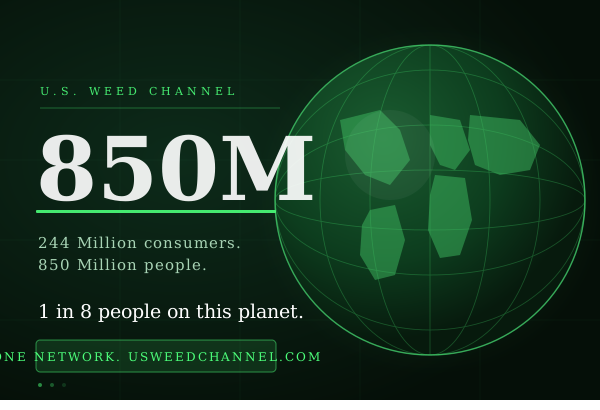
It's Not 244 Million. It's 850 Million. And They Represent 1 in 8 People on This Planet.
Slug: cannabis-consumers-850-million-global-media-audience
Meta Description: 244 million cannabis consumers. 850 million people including family. That's 1 in 8 people on earth — and U.S. WEED CHANNEL is the only network built to serve every single one of them. (184 characters)
Blog Post #4 — Full Draft
Title: It's Not 244 Million. It's 850 Million. And They Represent 1 in 8 People on This Planet. Category: Industry Data / Culture Target Keyword: "global cannabis consumers media audience"
Every conversation about cannabis media starts with the wrong number.
You'll hear 244 million. That's the global cannabis consumer population — the people who actually consume the plant. It's a staggering number on its own. It's larger than the entire population of Brazil. It dwarfs the United States. It represents one of the largest unified consumer segments on earth.
And it's still the wrong number.
Because cannabis doesn't stop at the consumer. It radiates outward — into households, families, workplaces, and communities. The spouse who doesn't consume but supports legalization. The parent who advocates for medical access for their child. The sibling who drives their veteran brother to the dispensary. The friend who attends the cannabis festival. The employee at the legal cannabis company who has never touched the plant.
When you account for the full social footprint of cannabis culture — the people whose lives are directly shaped by cannabis even if they don't consume it themselves — the number doesn't grow incrementally. It multiplies.
244 million becomes 850 million.
That is 1 in 8 people alive on this planet today. And not a single mainstream media network was built to serve them.
Until now.
Understanding the Real Number
The 244 million figure comes from the United Nations Office on Drugs and Crime's World Drug Report — the most comprehensive global survey of substance use conducted anywhere. It represents documented cannabis consumers: people who have used cannabis at least once in the past year across every legal market, gray market, and prohibition-era country on earth.
That number alone makes cannabis consumers the largest unified substance-use demographic in the world — larger than tobacco users in most developed markets, larger than the global alcohol consumer base in many regions, and growing at a rate that outpaces every other consumer category in the wellness and lifestyle space.
But the 850 million figure is where the real media opportunity lives.
Consider the household math. The average global household size is approximately 3.4 people. If a single cannabis consumer lives in each of those households — and research consistently shows that cannabis consumers skew toward household decision-maker demographics — the cultural and purchasing influence of that consumer extends to every person under that roof.
That's not a stretch. That's how every media company in history has calculated audience value. Nielsen doesn't just count the person holding the remote. They count the household. Spotify doesn't just measure the person wearing the headphones. They measure the family plan. The cannabis media audience has always been 850 million. The industry just hadn't built the infrastructure to reach them at that scale.
U.S. WEED CHANNEL did.
Who These 850 Million People Actually Are
The most persistent — and most damaging — misconception about cannabis consumers is demographic. The lazy cultural shorthand of the stoner, the burnout, the couch-locked twenty-something has been statistically demolished by a decade of legal market data. The actual cannabis consumer in 2026 looks nothing like that caricature.
Age. The fastest-growing cannabis consumer demographic is adults over 55. Baby Boomers and older Gen X consumers are returning to cannabis — often for the first time since the 1970s — driven by chronic pain management, sleep support, and anxiety reduction. This is not a youth counterculture. It is a mainstream wellness behavior.
Income. Legal market data consistently shows that cannabis consumers over-index in middle and upper-middle income brackets. They are homeowners, business owners, and professionals with significant discretionary spending power. They are exactly the demographic that premium advertisers spend billions trying to reach.
Education. Cannabis consumers in legal markets are statistically more likely to hold college and advanced degrees than the general population. The educated professional who uses cannabis after work the same way their parents used a glass of wine is not an edge case. They are the center of the market.
Geography. Cannabis consumption is not concentrated in coastal liberal enclaves. It is distributed across every state, every political affiliation, every income bracket, and every racial and ethnic demographic. The rural veteran managing chronic pain with cannabis and the urban creative professional using it for focus are both part of the same 244 million — and both part of the same 850 million.
Values. Cannabis consumers are among the most brand-loyal consumer segments ever studied. Research from legal markets consistently shows that cannabis consumers actively seek out and reward brands that engage with their community authentically. They remember who showed up before it was popular. They punish brands that engage cynically or retreat under pressure.
This is not a fringe audience. This is the mainstream — and it has been for years. Television just hasn't caught up.
The Media Gap That Created an Opportunity
Here is the paradox at the center of cannabis media in 2026: the audience is enormous, loyal, affluent, and growing — and the dedicated media infrastructure to reach them has been almost nonexistent.
Legacy broadcast television cannot serve this audience. Federal regulations, advertiser pressure, and network standards have kept cannabis content at arm's length from the major broadcast networks. Even as individual shows and documentaries have explored cannabis culture, no broadcast network has built programming, advertising infrastructure, or editorial identity around cannabis consumers as a primary audience.
Streaming giants have cannabis content. They do not have cannabis infrastructure. Netflix has cannabis documentaries. It also has cooking shows, true crime, and nature documentaries. Cannabis consumers are an afterthought in the algorithm — served occasionally, never centered.
Social media platforms have cannabis communities. They also have restrictive advertising policies that prevent brands from reaching those communities at scale, inconsistent content moderation that punishes cannabis creators without warning, and no compliance framework that protects advertisers who want to engage authentically.
The result has been a $50+ billion legal cannabis industry — projected to reach $100 billion by 2030 — with no dedicated media home. An audience of 850 million people with no network built in their image, in service of their interests, with the legal infrastructure to bring mainstream advertising dollars into their world.
That gap has a name: U.S. WEED CHANNEL.
What Reaching 1 in 8 People Actually Requires
Building media infrastructure for 850 million people is not the same as building a YouTube channel or launching a podcast. It requires federal recognition, platform distribution, advertising compliance, and editorial authority that takes years — sometimes decades — to establish.
U.S. WEED CHANNEL has spent 12 years building exactly that:
Federal Recognition. Three active USPTO trademark registrations covering Broadcasting & Streaming and Digital Advertising Services — the first cannabis-related intellectual properties ever issued by the USPTO to a media organization. Federal recognition that no competitor can replicate or shortcut.
Platform Distribution. Active, approved streaming presence across Roku, Apple TV, Google TV, iOS, Android, and the open web. Streaming in 5 languages to 180+ countries. USWC ROCKS Radio extending the network's reach into audio. Cannabis content — lifestyle, education, entertainment, and culture — available everywhere the 850 million already are.
Advertising Infrastructure. Google AdSense publisher approval. Amazon programmatic approval. Active approvals with LG, Samsung, and major OTT partners. A compliance architecture — anchored by C-CAT, the Cannabis Center for Advertising Transparency — that gives mainstream brands a documented, defensible, legally vetted pathway into cannabis media for the first time.
Editorial Authority. Four original television series. A film festival. A radio network. A blog built on 12 years of founder experience, legal precedent, and cultural credibility that no new entrant can manufacture.
The Trust Imperative
850 million people represent an extraordinary opportunity. They also represent an extraordinary responsibility.
The global cannabis community has spent decades being lied to — by governments, by media, by advertisers who exploited the culture without investing in it. They have watched prohibition destroy lives, watched legitimate businesses get raided, watched the plant they know as medicine get classified as more dangerous than opioids by the federal government.
They are not a passive audience waiting to be monetized. They are an active community with long memories and zero tolerance for inauthenticity.
Earning the trust of 1 in 8 people on this planet requires more than content. It requires a track record. It requires legal victories that prove you fought for the community, not just the revenue. It requires federal trademark protection that proves the network is built to last. It requires compliance infrastructure that proves mainstream participation can happen without betraying the values of the people who built this culture from the ground up.
That is what U.S. WEED CHANNEL was built to be. Not just a network. A trust infrastructure for the largest underserved media audience on earth.
The Question Every Media Brand Should Be Asking
1 in 8 people on this planet are connected to cannabis culture. They are loyal, affluent, growing in number, and currently served by media infrastructure that was not built for them.
The question is not whether this audience is valuable. That was settled by the data years ago.
The question is who earns their trust before the window closes — and who spends the next decade explaining why they waited. ~ Shane Doull
Shane Doull is the Founder and President of USWC Media, LLC, parent company of U.S. WEED CHANNEL and C-CAT. He writes about cannabis media, advertising compliance, and the future of cannabis culture from Newport Beach, California. He can be reached for comments, collaborations, and speaking engagements at +1 (424) 777-USWC (8792) ext 420.