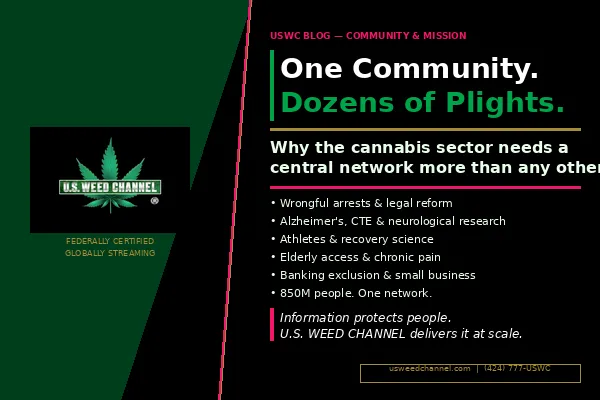
One Community. Dozens of Plights. Why the Cannabis Sector Needs a Central Network More Than Any Other.
No demographic on earth carries as many simultaneous, urgent, and underreported stories as the global cannabis community.
There are the veterans — hundreds of thousands of them — who have found relief from PTSD and chronic pain through cannabis, and who continue to face federal barriers to access because of the plant's Schedule I status. There are the elderly — Alzheimer's patients, arthritis sufferers, cancer survivors — whose quality of life has been measurably improved by medical cannabis, and whose physicians still cannot legally recommend it in most states without navigating a labyrinth of state-specific rules.
There are the children of the incarcerated — families fractured by cannabis arrests that, in many cases, would not be arrests at all today. There are the small business owners — dispensary operators, cultivators, ancillary businesses — crushed under federal banking restrictions that make legal cannabis commerce more dangerous and expensive than it needs to be. There are the researchers — scientists and medical professionals whose ability to study cannabis is hampered by the same federal classification that makes the research most needed the most difficult to conduct.
There are the athletes — professionals and amateurs alike — for whom cannabis has become a legitimate recovery and wellness tool, and who still navigate league policies written in an era when cannabis was understood as a performance-enhancing drug rather than what the evidence increasingly shows it to be: an anti-inflammatory, a pain management tool, and a sleep aid.
There are the parents — in legal states and prohibition states alike — trying to make informed decisions about a plant that exists in a media and information environment still shaped more by decades of government propaganda than by current science.
Every one of these stories matters. Every one of these communities deserves information, advocacy, and a media platform that takes their reality seriously.
And yet, the information that could serve all of them — that could lower their risk, improve their outcomes, and accelerate the cultural and regulatory change they need — is scattered, fragmented, and chronically underreported.
That is what a central cannabis network exists to fix.
The Information Gap and Why It Costs Lives
Information asymmetry in cannabis is not an abstract policy problem. It has direct, measurable consequences for real people.
Consider the elderly Alzheimer's patient whose physician cannot discuss cannabis as a treatment option because the federal classification creates liability exposure. Studies published in peer-reviewed journals have documented meaningful improvements in behavioral symptoms of Alzheimer's among cannabis users. This research exists. It is accessible to academics. It is almost entirely absent from the information environment that reaches the families of Alzheimer's patients — the people who could act on it.
Consider the veteran in a non-legal state managing PTSD with whatever the VA will prescribe — often opioids, with their documented addiction and overdose risks — while evidence accumulates in legal market research that cannabis can meaningfully reduce PTSD symptoms and opioid dependence simultaneously. The VA cannot discuss it. Local physicians are restricted. The information that could change this veteran's life is not reaching them.
Consider the parent of a youth football player watching their child absorb impacts that the research increasingly suggests carry long-term neurological risks. Cannabis-derived compounds — particularly CBD — are among the most studied potential interventions for traumatic brain injury and CTE-related neurodegeneration. This research is happening. It is not reaching the parents in the bleachers.
The gap between what the research knows and what the community receives is the information gap that a central cannabis network is uniquely positioned to close.
The Arrest Crisis: What Good Information Could Prevent
In 2022 — the most recent year for which comprehensive data is available — there were still over 200,000 cannabis-related arrests in the United States. This in a country where cannabis is legal in nearly half the states, where public support for legalization exceeds 70%, and where the federal government has publicly acknowledged that its cannabis policy is under review.
Those 200,000 arrests are not evenly distributed. Black Americans are arrested for cannabis possession at 3.7 times the rate of white Americans, despite roughly equal usage rates across racial groups. This disparity has persisted through decades of legalization advocacy and policy reform. It persists because the information that would allow communities to navigate their rights — to understand what is legal where, what protections exist, what to do in an encounter with law enforcement — is not consistently available to the people who need it most.
A central cannabis network is not just an entertainment platform. It is a public safety resource. The difference between a cannabis consumer who knows their rights in their jurisdiction and one who doesn't can be the difference between a warning and an arrest, between an expunged record and a conviction that follows them for decades.
USWC's mission — Protection, Prosperity, Education, and Entertainment — puts Protection first for exactly this reason. Information protects people. A central network that distributes that information at scale protects 850 million of them.
Health Benefits: The Story That Isn't Being Told
The health benefits research on cannabis is among the most rapidly evolving bodies of scientific literature in modern medicine. It is also among the most poorly communicated to the general public.
In the past decade, peer-reviewed research has documented meaningful evidence for cannabis efficacy in:
Chronic pain management. Cannabis has emerged as one of the most commonly cited alternatives to opioid pain management, with studies showing reduced opioid use among chronic pain patients with access to legal cannabis. In a country still navigating an opioid crisis that kills tens of thousands annually, this finding is not a footnote. It is a public health imperative.
Neurological conditions. Beyond Alzheimer's, cannabis research has produced meaningful results in epilepsy — leading to the FDA approval of Epidiolex, a CBD-based pharmaceutical — as well as in multiple sclerosis, Parkinson's disease, and other neurodegenerative conditions. The FDA approval of a cannabis-derived medication was a watershed moment in the normalization of cannabis medicine. Most of the 850 million cannabis-connected people don't know it happened.
Mental health. The relationship between cannabis and mental health is nuanced — involving both therapeutic applications and documented risks for specific populations — and that nuance is precisely why accurate, responsible information matters. The current media environment tends toward extremes: either cannabis cures everything or it causes psychosis. A central network with editorial standards and a commitment to evidence-based reporting can hold the nuance that partisan coverage cannot.
Athletic recovery. The World Anti-Doping Agency removed CBD from its prohibited substances list in 2018. The NFL, NBA, and MLB have all modified their cannabis policies in recent years. The story of cannabis as a legitimate athletic recovery tool — endorsed by professional athletes across multiple sports — is being told in fragments. A central network tells it whole.
The Prosperity Gap: Banking, Business, and the Cost of Prohibition
Cannabis businesses in legal markets operate under financial restrictions that no other legal industry faces. Because cannabis remains federally Schedule I, most federally insured banks will not offer standard commercial banking services to cannabis businesses. This forces legal operators to conduct business in cash — creating security risks, accounting complications, and operational costs that their non-cannabis competitors don't bear.
The SAFE Banking Act — legislation that would provide legal protection for financial institutions serving cannabis businesses — has passed the House of Representatives multiple times and stalled repeatedly in the Senate. The communities that would benefit most from its passage often don't know it exists, what it would do, or how to advocate for it.
A central cannabis network is the platform through which this information reaches the people who can use it. Dispensary owners. Cultivators. Ancillary businesses. Consumers who understand that the financial barriers facing their local dispensary affect the quality, safety, and stability of their access to legal cannabis.
Information about policy is not passive. When it reaches the right people at the right time, it becomes advocacy. And advocacy at the scale of 850 million people is a force that regulatory timelines cannot ignore.
Why Centralization Matters
The stories described above are not being ignored because they aren't important. They are being underreported because the infrastructure to tell them — at scale, consistently, with the editorial authority that comes from deep community roots — doesn't exist in cannabis media.
Fragmented platforms serve fragmented audiences. A dispensary blog reaches dispensary customers. A wellness podcast reaches wellness listeners. A legal advocacy newsletter reaches advocates. None of them reach all 850 million cannabis-connected people simultaneously, with a consistent editorial voice, across the full spectrum of the community's plights and possibilities.
That is what centralization provides. Not homogenization — the cannabis community is too diverse, too multidimensional, and too complex for a single voice to speak for all of it. But a central platform with multiple programming streams, multiple editorial perspectives, and a commitment to the full range of community experience can do something no fragmented ecosystem can: it can create a shared information environment for 850 million people.
A shared information environment is how communities become movements. It is how scattered stories become systemic change. It is how the veteran's pain, the grandmother's Alzheimer's, the young man's wrongful arrest, the athlete's recovery, and the parent's uncertainty all become part of the same urgent, undeniable narrative.
U.S. WEED CHANNEL was built to be that platform. The stories are waiting. The audience is ready. The infrastructure exists.
The only thing left is to tell the truth at the scale it deserves.
~ Shane
Shane Doull is the Founder and President of USWC Media, LLC, parent company of U.S. WEED CHANNEL and C-CAT. He writes about cannabis media, advertising compliance, and the future of cannabis culture from Newport Beach, California. He can be reached for comments, collaborations, and speaking engagements at +1 (424) 777-USWC (8792) ext 420.